Cataline Script: A Modern Handwritten Font for Small Business Branding
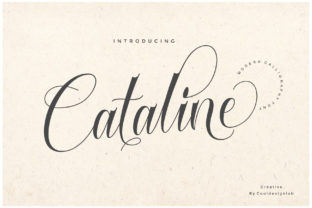
As a small business owner who designs my own packaging, updates Instagram stories weekly, and prints every thank-you card by hand, I’ve learned that typography isn’t just about “looking pretty.” It’s about showing up consistently—on a candle label, a café menu, a website banner, or a digital ad—and having customers instantly recognize *my* voice. That’s why I reached for Cataline Script: a fresh, modern calligraphy font with decorative characters and a gentle dancing baseline that feels intentional, not generic.
Cataline Script belongs to the Script Handwritten category—but it’s not overly ornate or hard to read. Its rhythm is relaxed but refined, its strokes confident without being flashy. It carries warmth and approachability, yet avoids looking childish or dated. That balance makes it especially useful for businesses where personality matters as much as professionalism: handmade skincare brands, independent bookshops, boutique fitness studios, wedding planners, artisanal bakeries, and even wellness coaches building trust through visual consistency.
I first used Cataline Script on my bakery’s seasonal menu board—and immediately noticed how it softened the layout while keeping it legible from six feet away. The slight baseline variation adds movement, like handwriting with intention, but the letterforms are generous enough to hold up at 24pt on a printed flyer or scaled down to 14pt on a product sticker. That readability across sizes is rare in expressive script fonts, and it’s what lets me use Cataline Script across so many real-world touchpoints without redesigning everything.
Here’s where it works best in practice:
- Logos & wordmarks: Cataline Script shines as a primary logo font for service-based businesses or lifestyle brands—especially when paired with a clean sans serif for taglines or contact info.
- Product labels & packaging: On matte-finish candle jars or kraft soap tags, its organic flow complements natural ingredients and thoughtful design.
- Thank-you cards & stationery: Because it feels personal and crafted, it elevates simple printed notes into meaningful brand moments.
- Social media graphics: On Instagram carousels or Pinterest pins, Cataline Script draws attention without competing with photography—it guides the eye instead of shouting.
- Website headers & hero banners: Used sparingly (not for body text), it adds character to headlines while maintaining fast loading and mobile responsiveness.
It’s important to be realistic: Cataline Script is a display font, not a workhorse. I don’t set paragraphs or pricing tables in it—and I wouldn’t recommend using it for small-print legal disclaimers or ingredient lists under 10pt. But as an accent, a signature, or a focal point? It delivers clarity *and* charm.
For pairing, I keep it simple: Cataline Script pairs beautifully with neutral, highly readable typefaces. A warm sans serif like Montserrat or Poppins grounds it in modern simplicity; a gentle serif like Lora or Playfair Display adds quiet elegance. The goal isn’t contrast for contrast’s sake—it’s harmony that supports your message. When I designed my coaching business’s welcome email, I used Cataline Script for the subject line and “You’re invited” header, then switched to Open Sans for everything else. Customers told me it felt “thoughtful but never fussy.” That’s the sweet spot.
Before committing to Cataline Script across your entire brand, test it in context. Print a mock-up of your product label at actual size. Preview an Instagram story with it overlaid on your most common background photo. Load it on your website and check how it renders on both desktop and iPhone Safari. Fonts can behave differently depending on platform, rendering engine, and file format—so seeing it live matters more than any font preview.
Licensing is another practical must-check. As a commercial font, Cataline Script requires a license that covers your intended use—whether that’s embedding in a Shopify theme, printing on merchandise, bundling into client deliverables, or including in digital templates you sell. Most reputable foundries offer clear licensing tiers (personal, standard, extended), and reading those terms upfront saves time and potential rebranding later. If you’re selling physical goods with Cataline Script on the packaging, make sure your license permits commercial production—not just digital use.
What sets Cataline Script apart isn’t just its aesthetics—it’s how reliably it translates your brand’s tone across formats. A café owner might use it for their chalkboard-style menu and loyalty card; a ceramicist could stamp it onto packaging tape and feature it in studio tour reels; a freelance designer might license it for client branding projects knowing it reads well on screen and in print. It bridges the gap between expressive and usable—a premium font built for real business needs, not just mood boards.
In a landscape where small businesses compete for attention with limited budgets and time, consistency builds credibility faster than any ad campaign. Cataline Script helps you say “this is us” without saying a word—whether it’s on a tiny tea bag tag or a full-screen Instagram ad. It doesn’t replace strategy or quality—but it does make your strategy easier to see, remember, and trust.
If you’re refreshing your brand identity or launching something new, try Cataline Script as your expressive anchor. Use it where people pause—even briefly—to connect with your story. Then pair it wisely, test it thoroughly, and let the rest of your materials support its voice, not compete with it. That’s how a single typeface becomes part of your brand’s quiet confidence.